Have you ever tried holding a plank? If so, you know the feeling. The first ten seconds are fine. Then the trembling starts. The burn sets in. Your brain starts screaming at you to just drop to your knees.
Recently, I stumbled across a YouTube video by Yellow Dude titled “The boring exercise that makes everything else easier”. It completely reframed how I look at the plank. The core message was simple: the plank isn’t just a physical exercise; it’s a mental one.
When you hold a plank, you’re basically practicing how to separate a physical sensation (the burn) from an emotional reaction (the urge to quit, the self-doubt). You’re building agency, the concrete belief that you can complete difficult tasks on purpose.
So I decided to try building the habit.
Down the science rabbit hole
Now, I’m definitely not a neurologist, but I went down a bit of a research rabbit hole after watching that video to see if there was any actual science backing this up. It turns out, there’s some pretty fascinating stuff out there.
First, there’s something called Brain-Derived Neurotrophic Factor (BDNF). It’s often described as “fertilizer for the brain” because it’s a protein that helps with neuroplasticity, learning, and memory. While reading through some research published on PubMed, I learned that physical exercise is one of the most potent ways to release BDNF. Isometric muscle contractions (like holding a plank) act as a signal to your brain to release these growth factors.
Then there’s the willpower aspect. I kept running into articles and podcasts (like Andrew Huberman’s discussions on neurobiology) talking about a specific brain region called the Anterior Mid-Cingulate Cortex (aMCC). Neuroscientists point to the aMCC as the literal seat of willpower. The interesting part? It actually grows when you force yourself to do things you don’t want to do. Engaging in sustained, uncomfortable holds like a plank is basically a direct workout for this part of your brain.
By starting with a manageable time and just adding a few seconds a day, you’re building the mental habit of following through on hard things.
A calming space to track it
What gets measured gets managed (or improved). Because I wanted to build this habit, I decided to code a tiny app for myself to track it.
Most fitness apps out there are loud. They have aggressive colors, intense alarms, and stressful leaderboards. Since I was approaching the plank as more of a mindfulness and mental health practice, I wanted something that felt the exact opposite.
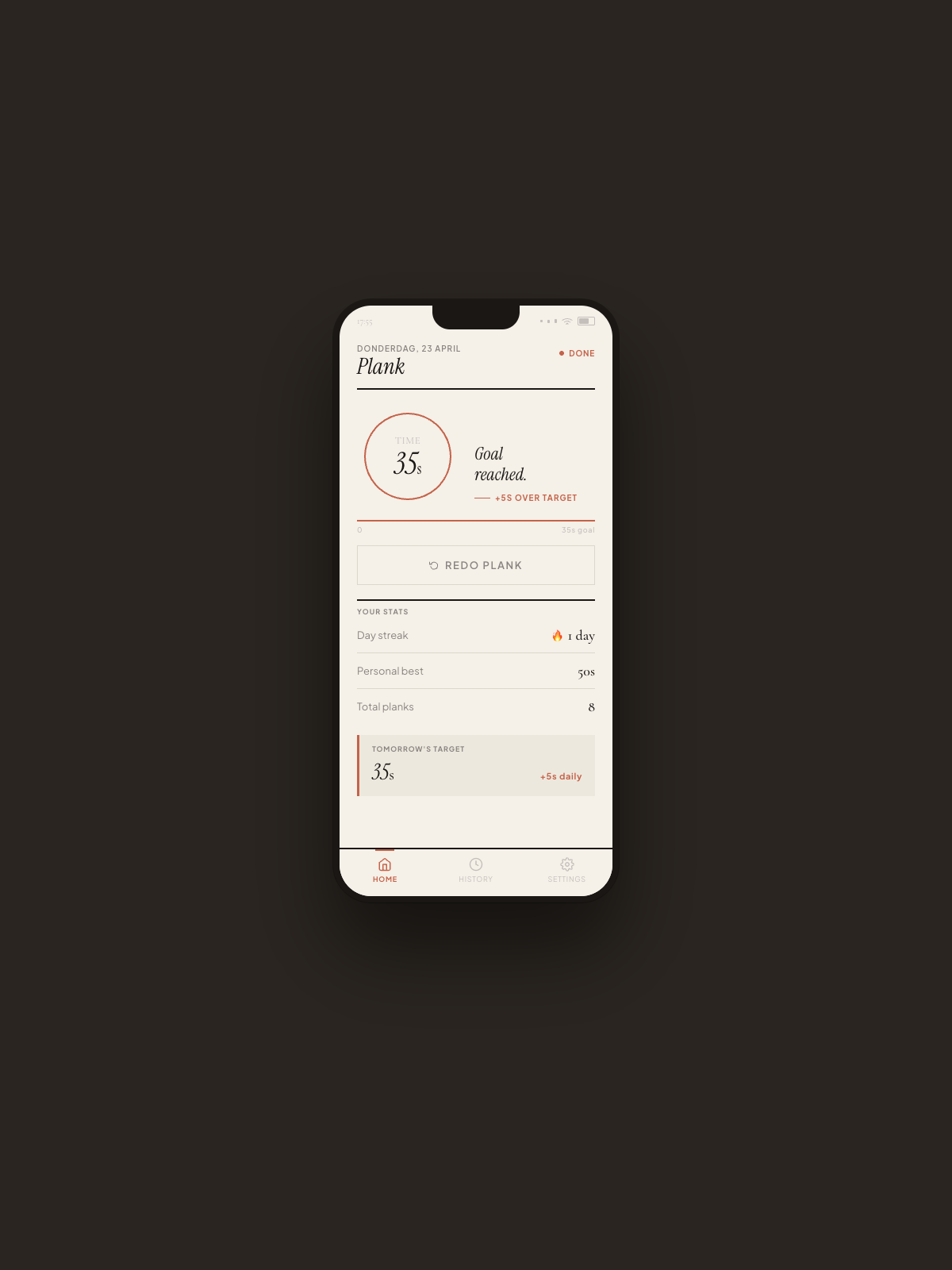
I designed it to feel like a warm, tactile piece of paper. No stress, no yelling—just a calm space to focus.
What it looks like
I’m just sharing this because I thought the concept was cool, but here is a little interactive demonstration of what I built. Notice the calming timer and the sparkline chart that tracks consistency over time, rather than just raw performance.
(You can actually click around the prototype above to see the different states: Running, Done, and the History view).
The plank is boring, it’s uncomfortable, and it’s hard. But maybe that’s exactly why we should do it.
I’m just putting this out there in case anyone else finds it helpful. If you want to try building your own mental resilience, you can check out the app on my GitHub. There’s an .apk there you can sideload onto your Android phone.